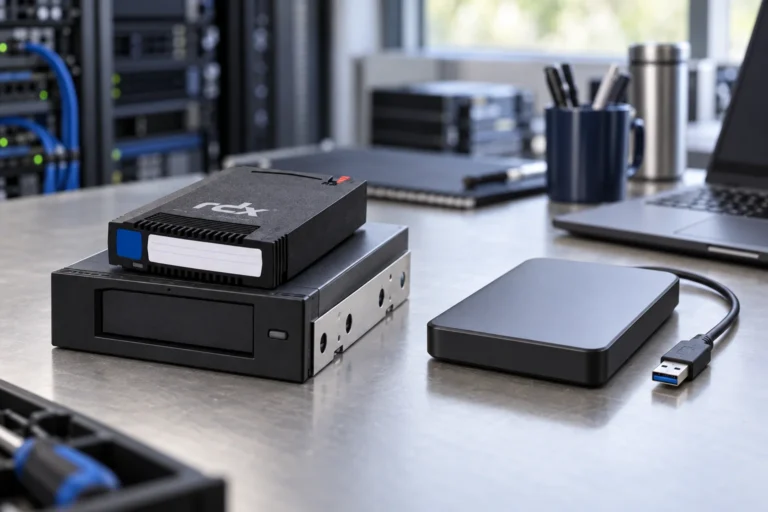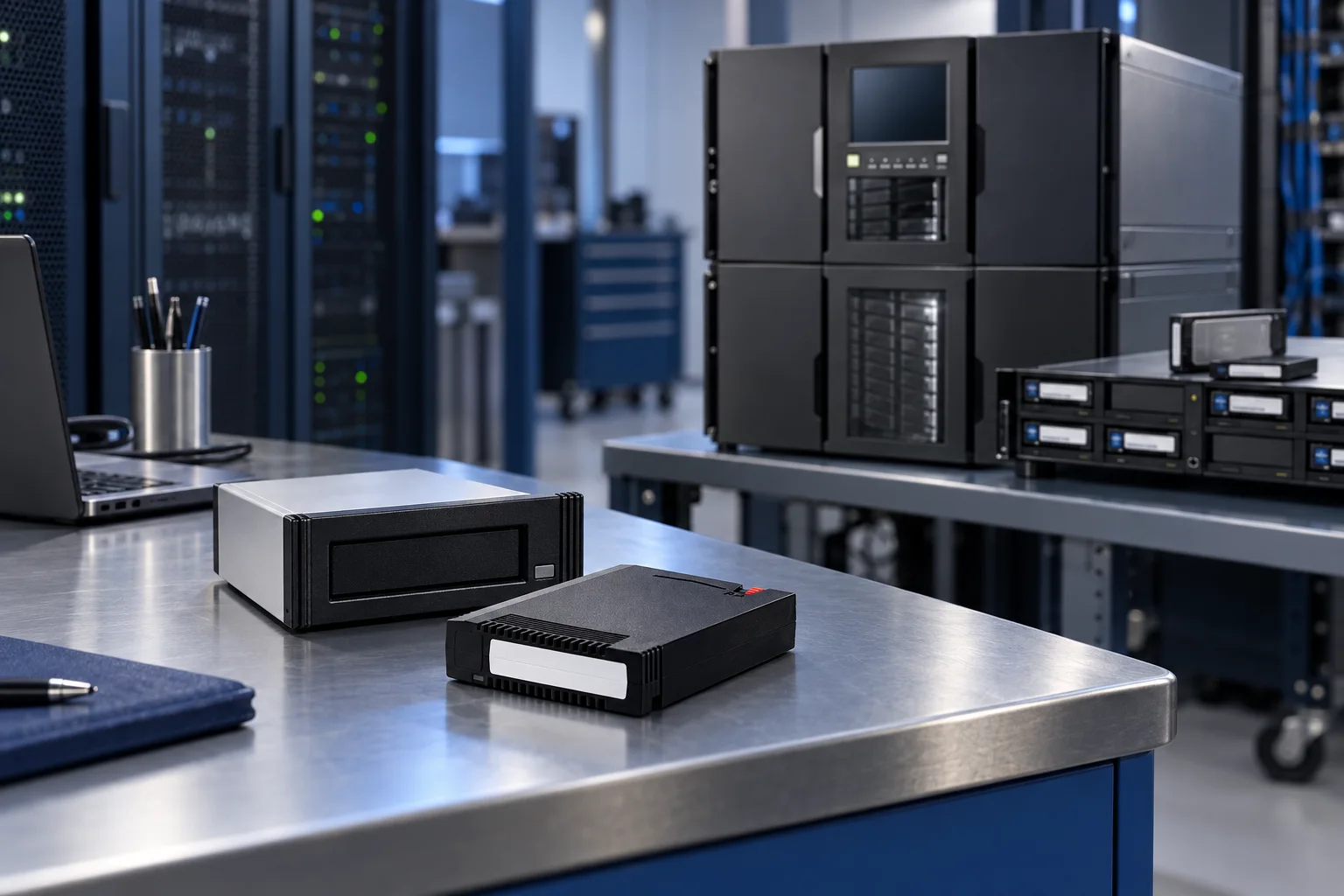
RDX and LTO are often compared as if they solved the same problem. They do not. One is commonly chosen for direct, day-to-day access to removable backup media; the other is commonly selected when retention and large volumes shape the design. The useful comparison starts with recovery, not with a capacity figure on a datasheet.
Make recovery the decision point
Ask the people who will use the backup three practical questions. What must they recover first? How long can that service be unavailable? And what would they need in their hands to complete the recovery?
That conversation usually exposes the difference between a copy that merely exists and a copy that is operable. A team that expects regular file-level restores, or has limited specialist resource, may value direct access and a predictable media-handling routine. A team retaining large, infrequently accessed data sets may put more weight on capacity, library workflow and long-term custody.
Where RDX tends to work well
RDX is removable storage used with disk-like access. In a practical backup process, that can make it easier to locate a particular backup set, carry out a targeted restore and hand a medium to the person responsible for off-site custody.
Its strongest use case is not “plug it in and forget it”. It is a disciplined rotation: named media, a visible handover record, an owner for each swap and a recurring restore test. Removing a completed medium from the connected environment can form part of an offline-copy process, provided the organisation also protects the media and knows where it is.
RDX can be a sensible route when you need:
- a recoverable local copy that a small IT team can operate without a tape workflow;
- simple, documented media rotation between an office and an approved off-site location;
- frequent tests of a selected file, virtual machine or small server recovery;
- a design that keeps an operational copy close to the people who need it.
Where LTO changes the balance
LTO tape is designed around high-capacity, long-retention use cases. That does not make it inherently harder to operate, but it does require a deliberate process for the drive or library, cartridge generation, catalogue, encryption and restore sequence. It is often a strong candidate where the retained data set is substantial and the business has a mature archive or backup operation.
The operational details matter. A cartridge is only useful if the correct drive remains available, its location is recorded, the backup application can catalogue it, and any encryption key can be retrieved through a controlled process. Tape may provide a physical separation option, but separation alone does not prove recoverability.
Use scenarios rather than a universal winner
For a branch office or small line-of-business server, the decisive question is often whether the on-call person can recover a required file or service with a documented, low-friction process. Direct access, clear media identification and repeatable handover may therefore outweigh a very long archive horizon.
For a large retained estate, the balance can change. Tape is commonly evaluated where retention, inventory discipline and high volumes are central, provided the organisation maintains the drive or library, catalogue, generations, access controls and recovery knowledge. A lower media cost does not remove the cost of a restore process that nobody has rehearsed.
Many organisations need neither a false choice nor a single tier. A readily accessible copy can serve ordinary recovery while a separately controlled copy addresses a different retention or incident-recovery need. The architecture should make these roles explicit.
Questions that expose a weak design
Could another authorised operator recover the data without the person who selected the technology? The answer must include the reader, backup application, permissions, media register, physical location and, where relevant, encryption material. A missing dependency is not a small administrative detail; it is a recovery risk.
Also rehearse an ordinary exception: a medium is late, a set is incomplete, a site is unavailable or a recovery starts outside normal working hours. The chosen design should preserve a known-good copy while the team handles the exception.
A short decision workshop
Use this workshop before asking for a quotation:
- Select a representative system and measure its protected data set.
- Set a recovery-time target for a realistic outage, not an ideal lab test.
- Identify how long copies must be retained and who owns off-site transport.
- Run a restore on the proposed workflow, including the time spent locating and preparing the media.
- Record every dependency: reader, software version, access rights, encryption material and contact.
If the process is too difficult to rehearse, it will be more difficult during an incident. It is perfectly valid to use different media for different recovery tiers. A directly accessible copy may support everyday recovery, while another, separately governed copy supports long retention or incident recovery.
Select with evidence
Ask for an architecture validation, then run a representative pilot. The useful outcome is not merely a throughput measurement or a successful job status. It is a record of what was restored, from which media, in what total time, with which prerequisites and what follow-up actions were identified. That is the evidence that connects a medium to a business recovery requirement.
The answer is a process, not a medium
Choose RDX when the operational priority is straightforward, hands-on recovery and a removable-media rotation your team can repeat. Consider LTO when capacity and retention requirements justify a tape-based operating model. In both cases, build the decision around a tested recovery scenario rather than an assumption about technology.
For the wider design, read the 3-2-1-1-0 rule, compare physical and logical air gaps, and use the restore-testing checklist.
Share this guide