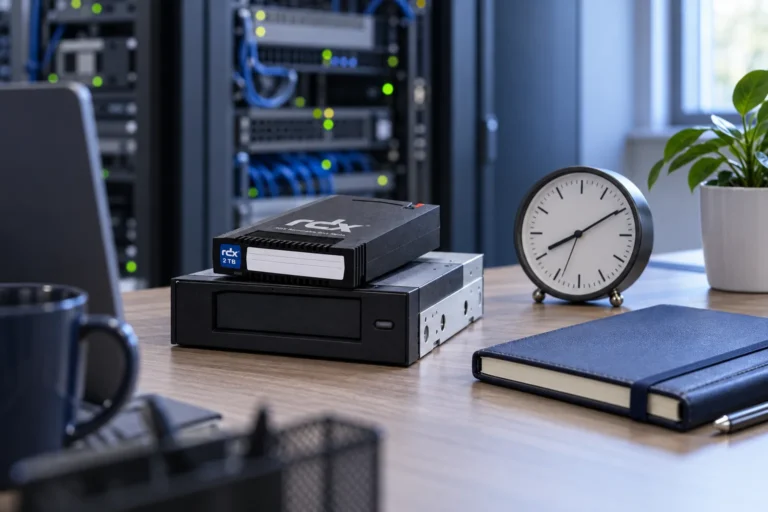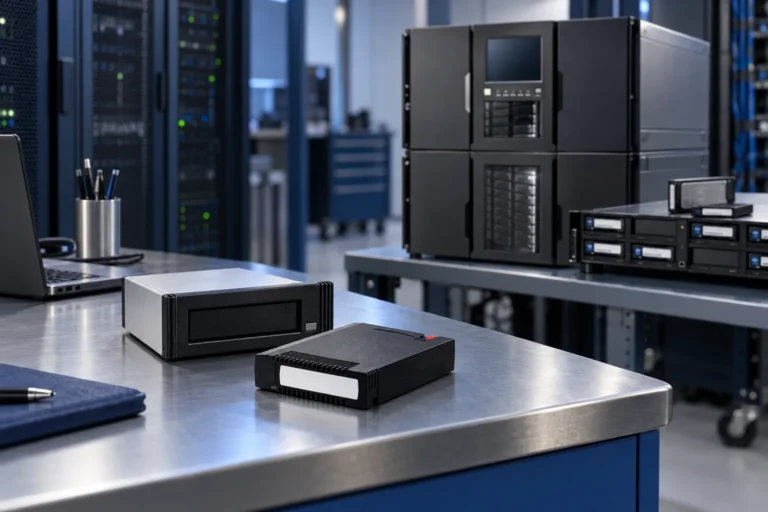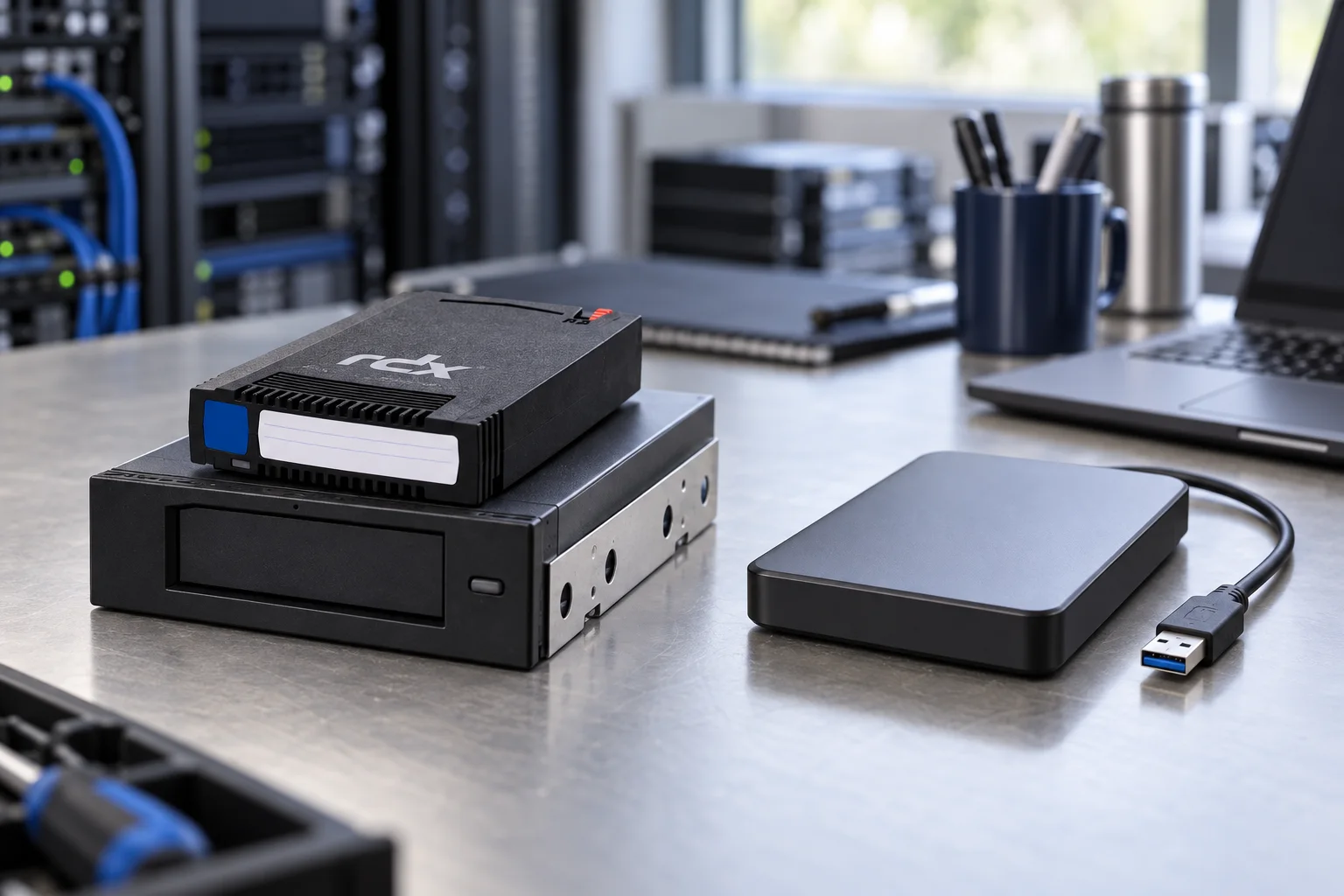
An external hard drive is not automatically an informal backup choice, and RDX is not automatically the professional answer. Both can hold a usable copy. The harder question is whether the people on duty can consistently identify that copy, move it out of the connected environment, account for it, and restore it when the person who designed the process is unavailable.
For a small organisation, this operating question is often more revealing than price per terabyte. A backup medium should support a repeatable recovery process, not merely make a successful job report more likely.
Start with the recovery task, not the device
Describe the incident that the backup must handle. Is the priority to recover one file from a workstation, bring a small server back after a hardware failure, or retain a separated copy while a wider incident is investigated? The answer changes the required media handling.
An external hard drive can be a sensible part of a tightly controlled process: it is labelled, encrypted where appropriate, removed after the job, entered in a register and stored separately. It becomes difficult to govern when several similar drives circulate without a handover record, when the latest one stays permanently attached, or when only one person knows which backup is on which device.
RDX uses removable cartridges with a dedicated drive. That can give a team a clearer operational unit: one cartridge has an identifier, a defined purpose in the rotation, a custodian and an authorised reuse date. It does not remove the need for policy. A cartridge with no register, no storage location and no restore test is still an uncertain recovery copy.
Score the workflow before comparing product references
How much change does the process have to absorb?
Measure the protected backup set and its expected growth, rather than only the capacity of the production disk. Include the versions retained, the space needed for headroom and the possibility that a complete set needs more than one medium. A design that fits exactly today can force premature reuse later.
Then consider how often media change hands. A quarterly copy managed by one owner does not create the same control problem as a daily or weekly rotation shared by several people. As exchange frequency rises, labels, status, availability and recorded responsibility matter more.
Can the copy be taken offline and kept under custody?
Removing a verified copy from the connected estate may be part of an offline-backup strategy, but only if the organisation can show where the copy went and who is responsible for it. A drive or cartridge left in the same room is exposed to a different set of risks from a copy held at another approved location.
Set the handover rules before choosing the medium: who takes it, how its arrival is confirmed, how an overdue return is escalated and when reuse is permitted. This applies equally to an external drive and to RDX media.
Could someone else complete the restore?
The useful test is not “can the backup administrator see a successful job?” It is “can another authorised person locate the right media, connect the required equipment, access the backup application and verify the restored data?” The dependencies often include a reader or interface, cables, software access, credentials, encryption material and the media register.
If one of those elements is undocumented, changing medium will not solve the underlying recovery risk.
Three common SME situations
One workstation or a very small protected scope
For a limited workload with a clear owner, an external drive may be proportionate. The workflow still needs a second independent copy, a record of the drive’s contents and a real test in which the expected data is recovered onto suitable equipment. A low-complexity process is a strength only while it remains genuinely easy to follow.
Regular backup rotation across a small team
When staff exchange media every day or every week, operational mistakes become more likely than a purely technical failure: the wrong device is reused, an off-site copy is not returned, a label is unclear or a known-good set is overwritten during an exception. A structured RDX rotation can make media identity and the regular exchange clearer for the team. Its value comes from the accompanying calendar and register, not from the name on the device.
A branch office with central IT oversight
A branch needs instructions that local staff can follow and central IT can audit without relying on informal knowledge. The selected workflow should define the person who makes the swap, the off-site destination, the action after a failed job and the route for collecting a required copy. Here, a consistent removable-media process can be more valuable than a technically ambitious setup that nobody can operate during an ordinary absence.
Run a custody and handover exercise
Take a recent backup and ask the person who would cover for the usual administrator to perform five actions:
- Identify the most recent verified set without guessing.
- Find the medium through the normal register and custody process.
- Confirm that the required reader, software and access rights are available.
- Restore an agreed sample and have the data owner check it.
- Preserve another known-good copy while the exercise takes place.
The result reveals where the decision belongs. If the team cannot complete the exercise with an external drive, it may need better labelling, custody and documentation. If it can complete it reliably, a more structured medium is not automatically necessary. If exchange, accountability and predictable reuse are the recurring weak points, a dedicated removable-media rotation deserves consideration.
Include operating effort in the cost comparison
Purchase cost is visible; recovery friction is usually not. Add the time spent identifying devices, chasing missing media, replacing a device at short notice, transporting copies, checking register entries and rebuilding a poorly documented restore path. Also include the effort of regular testing and the need for a spare when a media handover fails.
Conversely, a formalised setup has no value if it is rarely used or if its rules are ignored. The right total cost is the one that makes the agreed recovery service predictable over time, rather than the one that produces the cheapest first order.
Make a conditional, testable choice
An external hard drive can be appropriate for a contained workload with a disciplined owner, separated custody and proven recovery. RDX becomes relevant when the organisation needs readily identifiable media, a repeatable rotation and a shared operating routine across people or locations. Neither conclusion is universal, and neither is a substitute for a tested restore.
Use the offline media rotation guide, the air-gap guide and the backup-media sizing guide to build the process around the decision. When capacity, drive selection or a wider RDX architecture must be checked, direct the reader to the localised QuikStor range and solution pages on the Tandberg Data main site.
Share this guide